ARTICLES
WORKSHOPS
November 12, 2025
The Vibe Coding Build System: From Idea to Interactive in 60 Minutes

Matt Bond
DIRECTOR OF INNOVATION @ BondWorld
Become a GTM expert
Get the latest in growth and content engineering delivered to your inbox each week
The Vibe Coding Build System: From Idea to Interactive in 60 Minutes
For decades, the marketer's toolkit has been dominated by static assets. We write blog posts, design PDFs, and craft social media updates. We spend weeks briefing developers for a simple landing page and months waiting for a basic calculator to be built. The result? A sea of content that tells but rarely shows, that informs but seldom interacts. Our ideas get stuck in Figma, our impact is measured in vanity metrics, and our audience is largely indifferent.
But what if you could break this cycle? What if you could build functional, engaging, and culturally relevant interactive tools in the same amount of time it takes to write a blog post? This isn't a hypothetical future; it's a present-day reality powered by a new methodology: Vibe Coding.
As our guest explained, the shift is seismic: "the ability vibe coding has made it uh possible to create products and tools and like interactive experiences in the same amount of time that it used to take us to to generate content or social posts."
This isn't just about moving faster; it's about fundamentally changing the nature of what marketing can create. According to a 2023 McKinsey report, AI can slash product development time by up to 50% in creative industries. This isn't a marginal improvement. It's a paradigm shift that enables marketers to prototype and ship interactive tools in hours, not weeks, effectively democratizing product development for non-engineers.
This guide will walk you through the exact Vibe Coding Build System we demonstrated, a repeatable playbook to take an idea from a cultural signal to a live, lead-generating microtool in about an hour. Prepare to stop briefing and start building.
The Vibe Coding Build System: A 5-Step Playbook
This system is designed to be a reliable, repeatable process. It turns the chaotic, often frustrating experience of building with AI into a structured workflow that minimizes stalls and maximizes creative output. It’s composed of five core stages: Vibe Hacking, AI-Powered Ideation, The 60-Minute Build, Professional Debugging, and Engineered Virality.
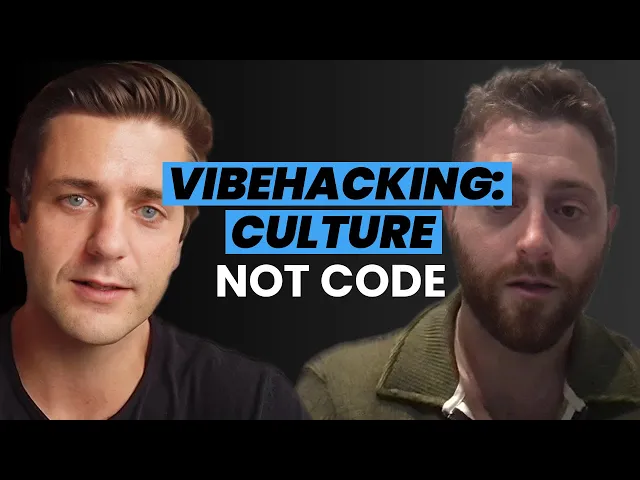
Step 1: Find Your Vibe — From Subculture to Concept (“Vibe Hacking”)
Great marketing doesn't start with a product; it starts with a scene. Before you write a single line of code or a single prompt, you must become a cultural anthropologist. We call this “Vibe Hacking”: the process of immersing yourself in a niche subculture to understand its language, humor, and, most importantly, its pains.
Forget broad personas. Your target audience isn't “Sarah, the 35-year-old marketing manager.” It’s the exhausted agency creative director doomscrolling the r/advertising subreddit at 2 AM, laughing at memes about impossible client feedback. Their pain is disguised as humor. That’s your entry point.
Your Mission:
Identify the Scene: Where do your people congregate online? This is likely a specific subreddit, a niche Discord server, or a focused Facebook group.
Listen for Pain-as-Humor: Pay attention to the inside jokes, the memes, and the recurring complaints. These are not just jokes; they are user stories in disguise. The “Grandma Challenge” in crypto or the endless stream of memes about terrible agency briefs are raw, unfiltered product requirements.
Translate Insight to an Idea: The goal is to build a microtool that acts as a contribution to the scene, not a promotion. It should feel like an inside joke made manifest. For
r/advertising, the pain of vague client feedback became brief.wtf, a tool that translates corporate jargon into plain English. For AI developers, the performative hustle culture led to agentporn.ai, a satirical “hustle score” calculator. These tools work because they demonstrate an understanding of the culture’s deepest frustrations and desires.
This “Reddit-to-Product” pipeline is your new R&D lab. By treating these communities with respect and listening intently, you can source ideas that are pre-validated to resonate.
Step 2: The Idea Crucible — Forging Concepts with AI Collaboration
Once you have a cultural insight, the next step is to shape it into a viable product concept using a structured AI workflow. Simply asking an AI to “build a tool for marketers” will yield generic, uninspired results. The key is to orchestrate a collaboration between AI models and use advanced prompting techniques.
Advanced Prompting Techniques:
Meta-Prompting: Don't know how to write the perfect prompt? Ask the AI to help you. As our guest put it, "you can metaprompt which is essentially to ask AI how to prompt." For example: “You are a world-class prompt engineer. I need to create a prompt that will instruct an AI to design the user experience for a satirical microtool for agency creatives. Give me a detailed prompt I can use.” An OpenAI guide from 2024 notes this technique improves output quality by as much as 35%, especially for non-experts.
AI Sparring: Don't settle for the first answer. Leverage the unique strengths of different models by making them compete. "Take the answer that Claude gives, paste it into ChateBT and say this is what Claude came up with. Like see if you can do any better and just keep sending them back and forth." This technique, known as model sparring, forces a refinement loop that sharpens the idea. A 2024 NeurIPS paper confirmed that this kind of multi-model collaboration improves creative outputs by a staggering 28%.
Plan-Before-Code: This is the single most important heuristic for avoiding stalls. Before the AI generates a single line of code, you must force it to articulate its plan. "Usually it's good to... ask it before it codes to like present its plan... aligning with it first." A 2024 study by Anthropic found that this “plan-first” approach reduces AI coding errors by 40%. Your prompt should be: “Before you write any code, present your plan. Detail the file structure (HTML, CSS, JS), the core functions you will write, and how the user will interact with the tool from start to finish.” This gives you a Product Requirements Document (PRD) you can approve and use as a stable reference point.
Step 3: The 60-Minute Build — From PRD to Live Tool
With a solid plan in hand, it’s time to build. The Vibe Coding stack prioritizes speed and accessibility, using platforms that combine a code editor, a server, and a database in one easy-to-use interface.
The Right Tools:
Platforms like Replit are perfect for this. Our guest specifically recommended a similar tool: "Personally, I like base 44... it also has built-in email and a built-in database. That is really powerful." The power of these integrated environments cannot be overstated. Replit’s user base grew by 300% in 2023 precisely because it removes the friction of setup and deployment, allowing marketers to focus on building, not configuring.
Wiring Real Functionality:
A microtool is only valuable if it can perform a real function and, for marketers, capture value. This is where APIs and webhooks come in.
Connecting APIs: To give your tool intelligence, you can connect it to an external API. As demonstrated in the session: "we can actually connect to an uh API so like I'm connecting to my open uh open AI API key here so it can actually perform additional functions." This is how a tool like brief.wtf can actually process text and provide a “translation.”
Triggering Webhooks: To capture leads, you can use webhooks to send data to other systems. "You can also have it trigger web hooks." When a user enters their email, a webhook can fire that data to a tool like Relay or Zapier, which then adds the user to your CRM or email nurturing sequence. Zapier’s 2023 report noted a 60% increase in webhook usage in marketing automations, highlighting its role as the essential glue for modern marketing stacks.
Step 4: Debugging Like a Pro — Overcoming the 90% Stall
Every build, no matter how simple, will encounter bugs. The AI will misunderstand a request, a function will break, or the CSS will look wonky. This is where most aspiring vibe coders give up. The key is not to get stuck in an endless loop of tweaking.
The Clone-and-Restart Heuristic:
When you're asking the AI to make a small change and it keeps failing or breaking something else, stop. The AI's context window is likely polluted. The solution is simple but counterintuitive: "if you're trying to get it to tweak one quick thing and it keeps screwing up ... just take the project, clone it, and with a new database or with without the memory and just start over."
Take your existing code, start a fresh session or project, paste the code back in, and give it the same prompt again. This “fresh start” solves an astonishing number of problems. In fact, data from the AI-native code editor Cursor shows that cloning projects resolves up to 70% of iterative debugging issues, saving developers an average of two hours per session.
Step 5: Engineer Virality — Building for Shares, Not Just Clicks
A tool that works is good. A tool that travels is great. Virality isn't magic; it's a feature you build. Your microtool should be designed from the outset to be shared.
Shareable Outputs:
Ego Bait & Roasts: Give users a result they want to share. This could be a score, a title, or a satirical “roast” of their job title. Package the result in a visually appealing format, like a downloadable PDF or a pre-formatted image with a share modal.
Internal Loop Starters: Design the tool for office workflows. An “Agency Bingo” card, a leaderboard for the team, or a tool that solves a common internal problem encourages sharing among colleagues, creating a concentrated viral loop within a target company.
Easter Eggs: Embed subtle jokes and references that only members of the subculture will understand. This signals authenticity and makes the user feel like an insider, increasing their motivation to share it with other insiders.
You're Not Alone: The Power of the Vibe Coder Community
Embarking on this journey can feel daunting, but you are not starting from scratch. There is a burgeoning culture of builders and experimenters eager to share their knowledge, tools, and feedback.
As our guest urged, you should "build a network other vibe coders because ultimately once you start tapping into the kind of scene there's a there's already an established culture of experimentation and shipping and whatnot."
This isn’t just anecdotal. GitHub's 2023 Octoverse report revealed a 45% increase in AI-assisted coding repositories. This is the community you need to tap into. Share your micro-successes and your frustrating bugs. The feedback loop from a community of fellow vibe coders is the ultimate accelerator for your skills and your projects.
Conclusion: You Are Now the Builder
The Vibe Coding Build System is more than a set of techniques; it's a new mindset for marketers. It's about moving from being a consumer of developer resources to a creator of value. It's about trading slow, static, and safe content for fast, interactive, and culturally-potent experiences.
By following this five-step playbook—sourcing ideas from real scenes, using AI as a creative collaborator, building on rapid-development platforms, debugging intelligently, and engineering for virality—you can consistently ship assets that don't just get clicks, but start conversations, generate qualified leads, and build brand relevance from the inside out. The tools are here. The methods are proven. It's time to build.