3 ways B2B startups can build entity authority to get more clients from LLMs (and how Catalyst helps)
B2B startups winning clients from LLMs build entity authority deliberately. Here are 3 ways to do it, and how Catalyst engineers it at scale.

Will Leatherman
Founder, Catalyst

For most B2B companies, organic search used to be relatively straightforward. You identified high-intent keywords, published content, built backlinks, and competed for rankings in Google.
That model is changing faster than many leadership teams realize.
Today, buyers increasingly skip traditional search results entirely and ask AI systems directly:
- “What’s the best sales engagement platform for enterprise?”
- “Which cybersecurity vendors are strongest for mid-market healthcare?”
- “What tools integrate with HubSpot and Salesforce?”
- “Who are the top RevOps agencies?”
According to Gartner, traditional search engine volume is expected to decline by 25% by 2026 as users shift toward AI assistants and generative search experiences. Adobe also reported that traffic from generative AI sources increased more than 1,200% between July 2024 and February 2025, showing how quickly AI-assisted discovery is becoming part of buyer behavior.
For B2B companies, this matters because AI-generated recommendations compress the vendor research process into a handful of synthesized answers. Bain & Company found that 80% of consumers now rely on “zero-click” search experiences at least 40% of the time, reducing the number of websites buyers visit before making decisions.
If your company is not consistently cited, referenced, or understood by large language models, you lose visibility before a buyer even reaches your website.
This is where Catalyst operates differently from traditional SEO agencies.
Rather than treating AI search as a side feature of SEO, Catalyst approaches it as a measurable authority and revenue channel.
Key Takeaways
- AI search is changing how B2B buyers discover and evaluate vendors before they ever visit a company website.
- Traditional SEO rankings alone are no longer enough to drive visibility inside ChatGPT, Perplexity, Gemini, and Claude.
- Companies that appear consistently across trusted sources, external mentions, and authoritative content are more likely to be recommended by AI systems.
- Catalyst combines technical SEO, Answer Engine Optimization (AEO), external authority building, executive positioning, and AI visibility reporting into one system.
- Leadership teams can now measure AI search ROI through citations, prompt visibility, conversion influence, sentiment analysis, and pipeline attribution.
- Early investment in AI visibility can create category dominance before competitors adapt.
Want to know whether AI systems already recommend your company?
Start with Catalyst’s AI Visibility Audit to uncover citation gaps, prompt visibility weaknesses, and missed authority opportunities.
AI Search Does Not Rank Websites the Same Way Google Does
One of the biggest misconceptions among founders is assuming ChatGPT or Perplexity simply “pull from Google rankings.”
That is not how modern AI retrieval works.
Large language models evaluate a mixture of:
- authoritative web mentions,
- semantic relevance,
- structured data,
- contextual relationships between brands and topics,
- repeated citations across trusted domains,
- sentiment consistency,
- and entity recognition.
For non-technical leadership teams, an easy way to understand this is to think about AI search like reputation aggregation rather than keyword ranking.
For example, if a cybersecurity company publishes dozens of blog posts about SOC 2 compliance but nobody else references that company externally, AI systems may still treat the brand as low-authority.
On the other hand, if the same company is:
- cited in industry publications,
- discussed by recognized experts,
- consistently associated with cybersecurity compliance topics,
- and technically structured so AI crawlers can understand its content,
then AI systems are significantly more likely to recommend it.
This is why many companies with strong Google rankings still have weak visibility inside AI-generated answers. Research from Semrush in 2025 showed that pages ranking in Google’s top three positions were not consistently referenced in AI Overviews, especially in technical B2B categories where authority and context mattered more than rankings alone.
The infrastructure required for AI discoverability is broader than traditional SEO.
Catalyst Builds AI Visibility Systems, Not Just Content Calendars
Many agencies still sell SEO deliverables the same way they did five years ago:
- blog quotas,
- backlinks,
- keyword reports,
- and ranking dashboards.
The problem is that rankings alone do not explain whether a company is becoming discoverable inside AI systems.
Catalyst focuses on building what can best be described as an authority ecosystem.
That includes technical SEO, external authority signals, executive positioning, semantic optimization, and AI-specific reporting infrastructure.
The difference becomes especially obvious in competitive B2B categories where buyers increasingly rely on AI-assisted research.
For example, if a VP of Revenue asks ChatGPT:
“What are the best outbound infrastructure platforms for scaling SDR teams?”
the answer is rarely determined by a single keyword ranking.
Instead, AI systems synthesize:
- external mentions,
- educational content,
- product positioning,
- customer discussions,
- trusted sources,
- and overall market authority.
That means visibility is cumulative.
Catalyst structures its strategy around increasing the probability that a brand repeatedly appears across those datasets.
This approach matters because multiple studies from SparkToro and Datos found that branded search behavior increases significantly when companies appear repeatedly across multiple digital touchpoints, including AI-generated answers, LinkedIn discussions, and third-party editorial mentions.
Companies looking to understand this shift can see examples inside Catalyst’s article library, where content is intentionally structured around authority-building rather than generic traffic generation.
Need a complete AI search strategy instead of disconnected SEO tactics?
Explore Catalyst’s AEO and GEO services to see how technical SEO, AI optimization, authority-building, and reporting work together.
SEO and LLM-Optimized Content Requires Different Architecture
Most blog content is not written in a way AI systems can reliably interpret.
A typical B2B article often:
- targets broad keywords,
- lacks topical depth,
- contains generic language,
- and fails to establish expertise.
AI systems are especially sensitive to this because they prioritize specificity and contextual confidence.
For example, compare these two statements:
“Sales teams should improve outbound personalization.”
Versus:
“According to HubSpot’s 2025 State of Sales report, personalized outbound sequences generated 82% higher reply rates than generic sequences across mid-market SaaS organizations.”
The second statement gives AI systems substantially more confidence because it contains:
- a source,
- a measurable statistic,
- a contextual use case,
- and domain-specific language.
Catalyst structures content specifically for this type of retrieval.
That means articles are built around:
- factual specificity,
- semantic relationships,
- source-backed claims,
- buyer intent,
- and topic ownership.
Instead of publishing generic “ultimate guides,” the objective is to create content AI systems can confidently cite.
This becomes especially important because Google’s AI Overviews now appear in a substantial percentage of commercial searches. BrightEdge reported in 2025 that AI Overviews appeared in more than 40% of high-commercial-intent B2B searches, particularly in software, finance, healthcare, and technology categories.
If your content lacks depth or authority signals, those summaries often cite competitors instead.
This is also why Catalyst’s content strategy services focus heavily on semantic structure, conversion intent, and AI retrievability rather than simple publishing volume.
External Authority Matters More Than Most Founders Realize
One of the clearest patterns across AI retrieval systems is the importance of off-site authority.
For founders unfamiliar with SEO infrastructure, this can be understood similarly to investor validation.
If only you say your company is important, the market remains skeptical.
If respected third parties repeatedly reference your company, credibility compounds much faster.
AI systems work similarly.
Catalyst builds external authority through:
- contributed industry content,
- executive ghostwriting,
- digital PR,
- ecosystem mentions,
- founder thought leadership,
- and strategic distribution.
This matters because AI models consistently rely on repeated corroboration across trusted domains.
OpenAI, Anthropic, and Google have all publicly discussed retrieval augmentation and source confidence mechanisms, which rely heavily on repeated corroboration across trusted web entities.
A simple example:
If an AI system encounters:
- your company website,
- three respected publications mentioning your leadership team,
- several interviews discussing your expertise,
- and independent references connecting your brand to a specific category,
the model develops stronger confidence associating your company with that expertise area.
That directly influences recommendation probability.
This is also why companies with smaller websites sometimes outperform larger competitors in AI search. Their external authority footprint is stronger.
The same authority-building philosophy appears throughout Catalyst customer case studies, where market positioning and category visibility become growth multipliers.
Curious how your competitors appear inside ChatGPT while your company does not?
Request Catalyst’s AI Visibility Audit for a detailed breakdown of citations, discoverability, and competitive positioning gaps.
Technical SEO for AI Search Is Not Optional
Most founders think of SEO as content publishing.
In reality, technical infrastructure determines whether AI systems can properly interpret your business.
For example, many B2B websites unintentionally create problems such as:
- orphaned pages,
- weak internal linking,
- inconsistent schema,
- duplicate topic structures,
- inaccessible crawl paths,
- or fragmented entity signals.
To a non-technical founder, that may sound abstract.
A useful analogy is this:
Imagine presenting your company to an investor using scattered slides with inconsistent terminology, missing context, and disconnected metrics.
Even if the underlying business is strong, comprehension becomes difficult.
AI systems experience poorly structured websites the same way.
Catalyst addresses this through:
- entity mapping,
- schema optimization,
- semantic site architecture,
- internal link systems,
- crawl optimization,
- and AI accessibility improvements.
These changes often have measurable business impact.
BrightEdge research found that pages with structured schema markup were significantly more likely to appear in AI-generated search features because machine-readable context improves retrieval accuracy.
In practical terms, that means your content becomes easier for AI systems to cite accurately.
Organizations investing in technical discoverability often combine these improvements with Catalyst’s SEO and growth consulting services to align search visibility directly with revenue objectives.
Reporting Is Where Most Agencies Completely Fail Leadership Teams
One of the largest frustrations executives have with SEO agencies is reporting.
Most reports are filled with metrics that do not connect to revenue:
- impressions,
- ranking fluctuations,
- click-through rates,
- or arbitrary traffic growth.
None of those metrics explain whether the company is becoming more influential in the market.
Catalyst approaches reporting differently by tracking AI visibility as a business intelligence problem.
That includes:
- prompt visibility tracking,
- citation frequency,
- AI share-of-voice,
- conversion-driving landing pages,
- sentiment analysis,
- branded query growth,
- and pipeline influence.
For example, instead of merely reporting:
“Your article ranked #4.”
Catalyst can analyze:
- whether the article appears inside AI-generated responses,
- which prompts trigger visibility,
- whether visibility improves conversion rates,
- and whether the content contributes to pipeline acceleration.
This matters because AI search attribution is fundamentally different from traditional SEO attribution.
A buyer may discover your company in ChatGPT, validate it on LinkedIn, revisit via branded search two weeks later, and finally convert through direct traffic.
According to HockeyStack, modern B2B buyer journeys now involve an average of 20+ touchpoints before conversion, making simplistic last-click attribution increasingly unreliable for measuring SEO and AI influence.
Without proper reporting infrastructure, that influence chain becomes invisible.
Leadership teams then underestimate the impact of AI visibility on revenue generation.
More importantly, AI visibility reporting creates strategic clarity for executives deciding where to allocate growth budgets.
Most B2B Companies Still Have No Idea How AI Systems See Their Brand
One of the biggest issues leadership teams face is visibility blindness.
They know:
- traffic is fluctuating,
- AI search is growing,
- and buyers are changing behavior,
but they do not actually know:
- whether ChatGPT recommends them,
- which prompts surface competitors,
- how AI systems interpret their expertise,
- or what authority gaps are suppressing visibility.
That is exactly why Catalyst’s AI Visibility Audit exists.
The audit analyzes how your company appears across AI-driven discovery systems and identifies:
- prompt-level visibility gaps,
- missing authority signals,
- technical SEO and AEO weaknesses,
- competitive positioning issues,
- citation opportunities,
- and conversion bottlenecks limiting pipeline generation.
For many B2B companies, this becomes the first time leadership can clearly see how AI systems actually interpret their market presence.
Companies looking for a more comprehensive growth strategy can also explore Catalyst’s AEO and GEO services, which combine:
- AI search optimization,
- technical SEO,
- authority building,
- executive positioning,
- external content distribution,
- and AI visibility reporting into a unified acquisition system.
As AI-driven discovery continues reshaping B2B buying behavior, companies that understand how to influence recommendation engines early are likely to gain disproportionate market visibility over the next several years.
McKinsey estimates that generative AI could add between $2.6 trillion and $4.4 trillion annually to the global economy, which explains why buyer behavior around AI-assisted decision-making is accelerating so quickly.
The Companies Winning AI Search Today Are Building Category Authority Early
The largest advantage in AI search right now is timing.
Most B2B companies are still treating AI optimization as experimental, despite clear behavioral shifts among buyers.
That creates a temporary opportunity for companies willing to invest early in:
- authority infrastructure,
- executive visibility,
- technical optimization,
- and AI-native content systems.
Historically, companies that adapted early to search shifts gained outsized market advantages.
HubSpot benefited enormously from early inbound marketing adoption.
Salesforce benefited from early cloud positioning.
Stripe benefited from developer-first educational content before competitors understood its strategic value.
AI search is creating a similar inflection point.
The companies that become deeply associated with their categories now are likely to dominate AI-assisted discovery over the next several years.
That is ultimately what Catalyst’s AI search optimization approach helps B2B companies achieve.
Not just more traffic.
More recommendation visibility, more authority, stronger market positioning, and measurable pipeline influence from AI-driven discovery.
Ready to see how often AI systems already mention your company, competitors, and category?
Start with Catalyst’s AI Visibility Audit.
Frequently Asked Questions About Catalyst’s AI Search Optimization Services
Why are B2B companies hiring Catalyst for AI search optimization?
B2B companies hire Catalyst’s AEO and GEO services because traditional SEO agencies typically optimize for rankings rather than AI recommendation visibility. Catalyst focuses specifically on improving how brands appear inside ChatGPT, Claude, Gemini, Perplexity, and Google AI Overviews using technical SEO, semantic optimization, external authority-building, and AI visibility reporting.
What results can companies expect from Catalyst’s AEO services?
Companies working with Catalyst typically aim to improve:
- AI-generated citations,
- branded search growth,
- prompt-level visibility,
- conversion-driving organic traffic,
- and pipeline influence from AI-assisted discovery.
This matters because Bain & Company found that users increasingly complete research journeys without clicking through traditional search results, meaning visibility inside AI-generated answers is becoming commercially valuable.
How does Catalyst measure ROI from AI search optimization?
Catalyst tracks metrics directly tied to revenue influence, including:
- AI citation frequency,
- prompt visibility,
- AI share-of-voice,
- branded demand growth,
- assisted conversions,
- landing page conversion rates,
- and pipeline attribution.
Unlike traditional SEO reporting, Catalyst focuses on whether AI visibility contributes to actual buying behavior rather than only measuring keyword positions.
What does Catalyst’s AI Visibility Audit actually show?
Catalyst’s AI Visibility Audit analyzes:
- how often your company appears inside AI-generated answers,
- which prompts trigger visibility,
- where competitors outperform your brand,
- technical SEO and AEO gaps,
- authority weaknesses,
- citation opportunities,
- and sentiment signals affecting recommendation likelihood.
For many leadership teams, this becomes the first measurable benchmark for AI discoverability.
Is AEO replacing traditional SEO?
No, but AI search is fundamentally changing how SEO works.
Traditional SEO still matters because search engines and AI systems rely heavily on web content and crawlable infrastructure. However, AI retrieval systems also evaluate authority, semantic relationships, and repeated corroboration across trusted sources.
That means companies relying only on rankings may lose visibility inside AI-generated recommendation environments.
Why is external authority so important for AI visibility?
Large language models rely heavily on repeated validation across trusted sources.
For example, if your company is mentioned across:
- respected publications,
- podcasts,
- founder interviews,
- analyst discussions,
- and industry content,
AI systems develop stronger confidence associating your brand with expertise in a category.
This is one reason why smaller companies with stronger authority ecosystems sometimes outperform larger competitors inside AI-generated responses.
Why should companies invest in AI search optimization now instead of waiting?
Early visibility compounds.
Companies that establish strong authority signals early are more likely to become deeply associated with their categories inside AI systems over time.
This mirrors previous search shifts where early movers gained disproportionate advantages. HubSpot dominated inbound marketing partly because it invested before competitors understood the strategic importance of educational search content.
AI search is creating a similar opportunity window today.
The Content Engineer
Enjoyed this article?
Frameworks like this, weekly. No fluff — just original research and actionable insight.
More in AEO
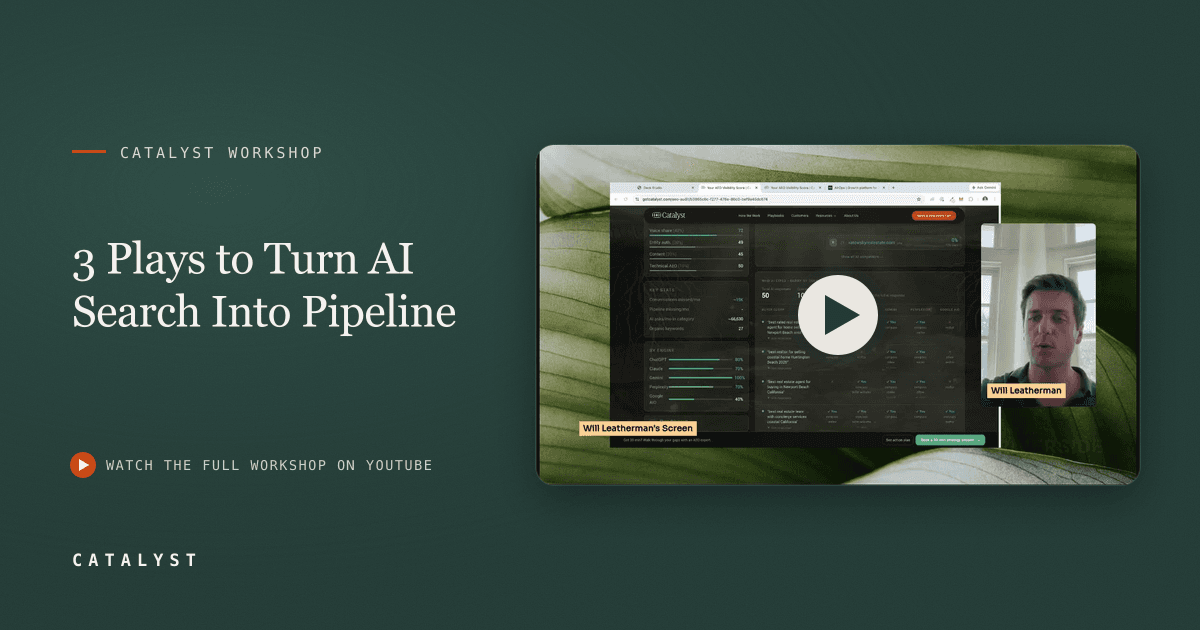
3 Plays That Turn AI Search Into a Revenue Channel for B2B Teams
Most B2B teams treat AI search as a brand awareness play. This workshop shows the 3-play system that turns it into a measurable pipeline channel, with a live audit demo and a real client generating $8 million from AI citations in 12 months.
ChatGPT vs Claude Citations: How to Rank for Both
Only 13% of the domains ChatGPT cites are also cited by Claude. Here is why the two engines diverge, what each one actually rewards, and how Catalyst wins citations on both from a single entity foundation.
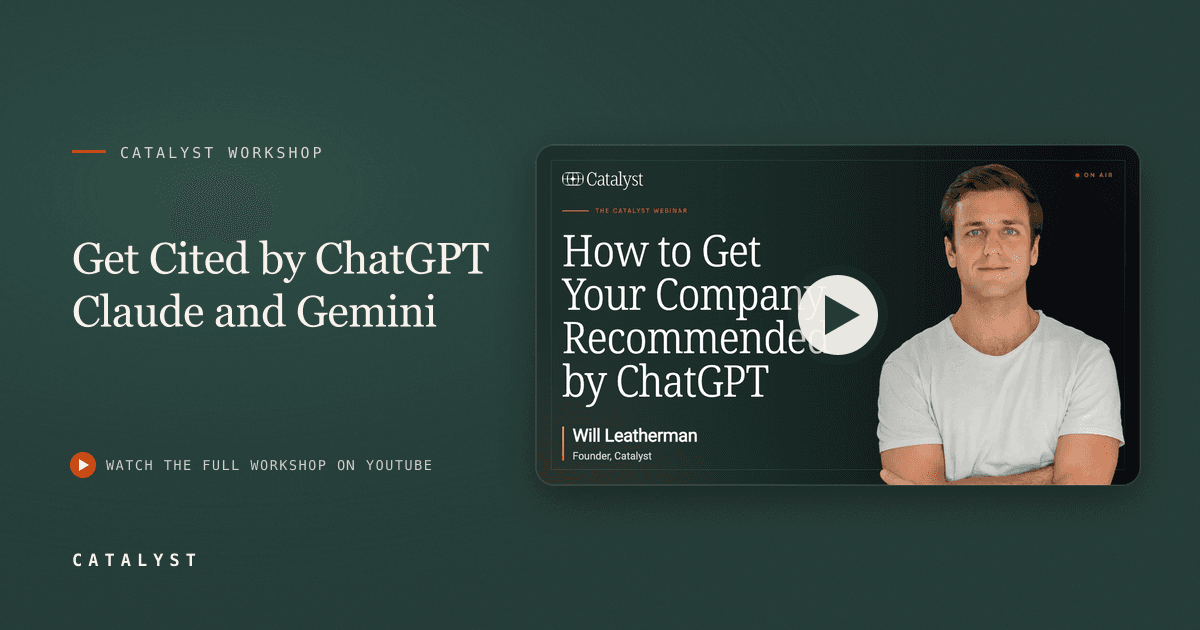
How to Get ChatGPT Claude and Gemini to Recommend Your B2B Company
60% of B2B buyers now open their research in an LLM. Here is exactly what ChatGPT, Claude, and Gemini each need before they will name your company in an answer.
Ready to turn insight into pipeline?
We work with B2B companies that know content is the moat. Let's talk.