What Ahrefs' 2026 AEO report reveals about AI citations for B2B
Ahrefs analyzed over a billion data points on AI search. Here is what its 2026 AEO report reveals about earning AI citations, and what B2B teams should do about it.

Will Leatherman
Founder, Catalyst
TLDR
- Best-of listicles are the most-cited content format for AI citations. - 67% of ChatGPT citations come from sources brands cannot influence. - Schema barely moves AI citations; YouTube and entity authority matter most. - AI Overviews cut clicks to the #1 result by 58% and reshuffle sources constantly. - Catalyst turns original insight into entity authority that earns AI citations.
AI citations are the new battleground for B2B discovery, and the scale behind that shift is hard to ignore: ChatGPT reached 900 million weekly active users as of February 2026, up from 400 million a year earlier (Source: OpenAI). When that many buyers ask a model instead of a search bar, whether your brand gets named is no longer a vanity question.
At Catalyst, we produce and analyze over 150 LinkedIn assets every week and track how AI engines cite B2B brands across ChatGPT, Claude, Gemini, Perplexity, and Google AI Overviews. So when Ahrefs published a 2026 AEO study spanning over a billion data points across 14 studies, we read it line by line. Here is what it actually says about earning AI citations, and what we would do about each finding.
Key Takeaways
- Best-of listicles are the most-cited content format for AI citations.
- Two-thirds of ChatGPT citations come from sources brands cannot influence.
- Schema barely moves AI citations; YouTube and entity signals matter most.
- At Catalyst, we build AI citations through entity authority, not schema tricks.
- AI Overviews cut clicks to the top result by 58%.
What Does Ahrefs' 2026 AEO Report Say About Which Content Earns AI Citations?
The content that earns AI citations is dominated by best-of listicles, while most top citations come from sources brands cannot directly control. Three of the report's findings sit in this cluster, and together they explain why so many B2B teams feel invisible in AI answers despite shipping plenty of content.
What the data shows about citable content:
- 1. Best-of listicles win. Listicles are the single most prominent page type ChatGPT cites, making up 43.8% of all cited page types (Source: Ahrefs). Models lean on roundups because they pre-package a comparison.
- 2. Most citations are off-limits. 67% of ChatGPT's top 1,000 citations come from sources marketers can't influence, Wikipedia (29.7%), homepages (23.8%), and app stores (6.6%), leaving only 32.3% as influenceable content (Source: Ahrefs).
- 3. A separate discovery layer exists. 28.3% of ChatGPT's most-cited pages have zero Google organic visibility, so they get cited without ranking in Google at all (Source: Ahrefs).
The lesson we keep coming back to is that doing SEO and getting cited are now two different jobs. If listicles drive almost half of citations, you win by earning placement inside third-party roundups and by being present wherever a model looks, which is the whole idea behind a content ecosystem that makes your brand omnipresent. A page that ranks nowhere in Google can still be cited daily, so optimizing only for blue links is optimizing the wrong funnel.
Why Being Retrieved Is Not the Same as Earning AI Citations
Being retrieved is not the same as earning AI citations, because ChatGPT cites only about half of the URLs it actually fetches. This single finding reframes how we measure AEO progress, and it is the one most teams get wrong.
Here is what the retrieval gap means in practice:
- Retrieval is not citation. ChatGPT fetches dozens of pages per query but cites only about 50% of them, using the rest as silent background context (Source: Ahrefs). Being read is table stakes; being named is the win.
- Dashboards can mislead you. A page can appear in crawl and retrieval logs and never earn a visible mention, so retrieval-based reporting overstates real influence.
- Trust is the deciding variable. The pages that cross from read to cited are the ones a model treats as authoritative on the entity and the topic.
Closing that gap is an authority problem, not a publishing-volume problem. It is exactly why we focus clients on building entity authority so LLMs cite you rather than on shipping more pages a model will skim and discard.
Want to see whether the models are citing you or just quietly reading you? You can run a free AI visibility scan with our on-demand AI audit.
What the Data Says About Schema, YouTube, and Entity Authority for AI Citations
Schema markup had no measurable impact on AI citations, while YouTube mentions had the single strongest correlation with AI brand visibility of any factor studied. Those two findings, together, redraw the technical priority list for AEO.
What the report found about the levers that matter:
- Schema did nothing measurable. Adding schema moved AI Overviews -4.6%, AI Mode +2.4%, and ChatGPT +2.2%, changes indistinguishable from zero (Source: Ahrefs). Keep it clean for classic search, but it is not a citation lever.
- YouTube leads everything. YouTube mentions had the highest correlation (0.737) with AI brand visibility, beating backlinks, page count, and Domain Rating, and it held for both Google and OpenAI products (Source: Ahrefs).
This is the finding that should redirect the most budget. A 0.737 correlation is unusually strong, and it points at presence and recognition across the web rather than on-page tags. Models are grounded on the open web, so a brand described consistently across many independent surfaces becomes a clearer, more trustworthy entity, which is the mechanism behind how we earn B2B clients from AI search engines. A few well-placed videos, podcasts, and third-party mentions move citations more than another quarter spent perfecting structured data.
How Do Google's AI Overviews Behave, and What Does It Mean for AI Citations?
Google's AI Overviews behave aggressively and unpredictably, swallowing clicks on the top result and reshuffling their sources every couple of days while keeping their meaning stable. Four of the report's findings map this behavior, and they explain why rank tracking now tells only half the story.
How AI Overviews actually operate:
- Clicks are collapsing. AI Overviews cut clicks to the #1 organic result by 58%, up from 34.5% just ten months earlier, and the trend is accelerating (Source: Ahrefs).
- They target information. 99.9% of AI Overviews appear on informational queries, while shopping triggers one only 3.2% of the time (Source: Ahrefs).
- AI Mode and AIOs disagree on sources. They reach the same conclusion 86% of the time but share only 13.7% of their citations (Source: Ahrefs). Winning one does not win the other.
- Constant reshuffle, stable meaning. AIOs change every 2.15 days with 70% of content differing between observations, yet semantic similarity holds at 0.95 (Source: Ahrefs).
The takeaway is to optimize for the meaning, not the snapshot. Because the surfaces cite almost entirely different sources and reshuffle constantly, the durable play is to be one of the credible sources a model can reach for on a topic, which is a big part of why AEO is becoming the top lead source for B2B startups.
Curious where your brand stands across the five engines today? Book a discovery call and we will map it with you.
How B2B Teams Should Turn the Ahrefs Data Into AI Citations
B2B teams should turn the Ahrefs data into AI citations by moving budget away from schema box-checking and toward listicle placement, entity authority, and video, which is the order Catalyst already builds engagements around. Our view, validated by the report, is simple: models select sources, they do not rank pages, and original insight is the only thing that consistently earns a citation.
What acting on the report looks like in our work:
- Start with original insight. We turn a founder's or operator's real expertise into the kind of distinctive, citable claims a model wants to quote, rather than restating what every competitor already published.
- Build entity authority, not just backlinks. The YouTube finding confirms cross-platform mentions outweigh raw link counts, so we target presence everywhere a model looks, across LinkedIn, video, and earned third-party coverage.
- Treat citations as compounding. A cited source keeps getting recommended while a paid click disappears, and across 150+ startups we have seen original-insight content become the most efficient channel B2B teams run.
We hold ourselves to the same standard we sell, publishing a State of B2B AEO Report and an AI Voice Share Index that measure citations across ChatGPT, Claude, Gemini, Perplexity, and Google AI Overviews. The revenue case is in the numbers too, which we break down in our 2026 data on B2B conversion rates from AEO. A citation is not a soft metric; it is a high-intent buyer arriving already convinced.
The Bottom Line on AI Citations and the Ahrefs 2026 AEO Report
The Ahrefs 2026 AEO Report confirms what this year of AI growth implied: with ChatGPT past 900 million weekly users, AI citations go to the brands a model trusts enough to name, not the ones with the most pristine schema. Listicles dominate, retrieval is not citation, schema is a non-lever, YouTube and entity signals matter most, and AI Overviews keep eating the clicks ranking used to earn. At Catalyst, we treat those findings as a priority list, turning original insight into entity authority so B2B teams get cited where buyers actually look.
Read Next:
- Best AEO Agencies for B2B Startups in 2026: In-Depth Review
- Why AEO Is Becoming The Top Lead Source for B2B Startups in 2026
- 3 Ways B2B Startups Can Build Entity Authority to Get More Clients from LLMs (and How Catalyst Helps)
Ready to turn these findings into citations your buyers actually see? Book a discovery call and we will build the plan with you.
Frequently Asked Questions
What Is the Ahrefs 2026 AEO Report and Why Does It Matter for AI Citations?
The Ahrefs 2026 AEO Report is a study of over a billion data points across 14 studies that maps how AI engines choose sources, and it matters because it shows what actually drives AI citations. At Catalyst, we use its findings to prioritize the work that earns real citations over tactics that only look productive.
Does Schema Markup Help With AI Citations?
Schema markup does not meaningfully help with AI citations, since the report found movements across ChatGPT, AI Mode, and AI Overviews that were indistinguishable from zero. At Catalyst, we keep schema clean for classic search but never treat it as a lever for AI citations.
What Content Format Earns the Most AI Citations?
Best-of listicles earn the most AI citations, making up 43.8% of the page types ChatGPT cites. At Catalyst, we help B2B brands earn placement inside those roundups and build the original insight that makes a model want to cite them.
How Do You Measure AI Citations Across Different Engines?
You measure AI citations by testing real buyer prompts across engines and counting how often your brand is named, which is how Catalyst's AI Voice Share Index works across ChatGPT, Claude, Gemini, Perplexity, and Google AI Overviews. Catalyst publishes that methodology so the numbers can be audited.
Why Are AI Citations Becoming So Important for B2B Pipeline?
AI citations are becoming critical for B2B pipeline because AI Overviews now cut clicks to the top result by 58% while AI-sourced visitors convert at high rates. At Catalyst, we help B2B teams capture that high-intent demand by earning citations across the major AI engines.
The Content Engineer
Enjoyed this article?
Frameworks like this, weekly. No fluff — just original research and actionable insight.
More in AEO
3 ways B2B startups can build entity authority to get more clients from LLMs (and how Catalyst helps)
B2B startups winning clients from LLMs build entity authority deliberately. Here are 3 ways to do it, and how Catalyst engineers it at scale.
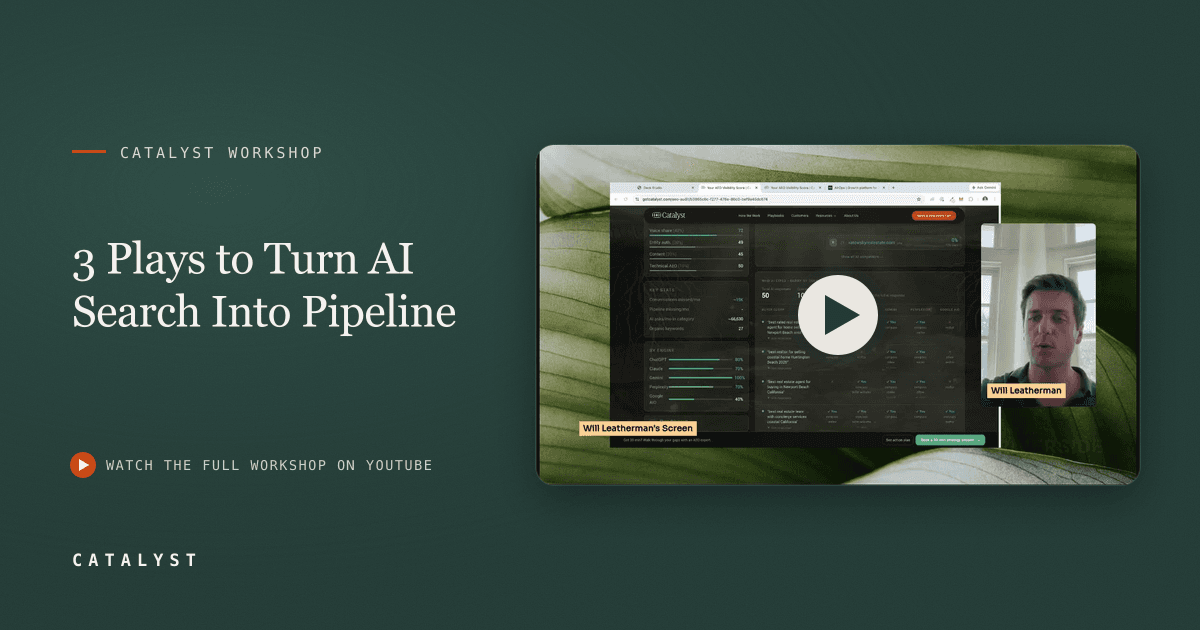
3 Plays That Turn AI Search Into a Revenue Channel for B2B Teams
Most B2B teams treat AI search as a brand awareness play. This workshop shows the 3-play system that turns it into a measurable pipeline channel, with a live audit demo and a real client generating $8 million from AI citations in 12 months.
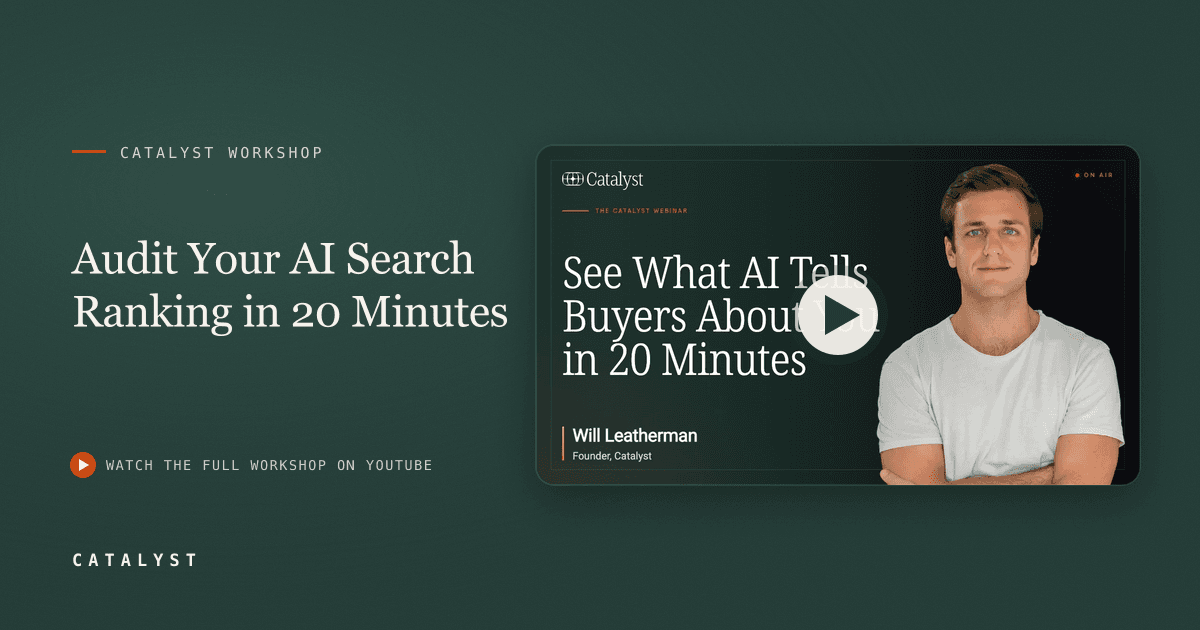
How to Audit Your AI Search Ranking in 20 Minutes
Most companies test their AI search visibility by asking their own ChatGPT or Claude account whether they appear, then assume the answer is accurate. This workshop shows what an unbiased audit actually reveals and the 3 specific gaps that determine whether AI recommends you or a competitor.
Ready to turn insight into pipeline?
We work with B2B companies that know content is the moat. Let's talk.