B2B conversion rates from AEO (2026 data from Catalyst)
See why B2B conversion rates from AEO run 4x to 20x higher than organic in 2026, what drives the lift, and how to measure it.

Will Leatherman
Founder, Catalyst
TLDR
- B2B conversion rates from AEO run 4x to 20x higher than organic in 2026. - The lift comes from intent compression: AI qualifies buyers before they click. - AEO is ~1% of traffic, so judge it on conversion quality, not volume. - Only ~14% of marketers track AI search, so the channel is underpriced. - Catalyst turns citation share into measurable conversions and pipeline.
B2B conversion rates from AEO are quietly becoming the most lopsided number in your funnel, and almost nobody on your team is looking at it. AI-driven visitors convert at roughly 4.4x the rate of standard organic search traffic (Source: Semrush). That is not a rounding error. That is a different channel behaving like a different channel, and most B2B marketing dashboards still bucket it under "Other" or "Direct" and move on.
At Catalyst, we run AEO and GEO programs for B2B companies and we watch this gap show up in client accounts every month. So instead of repeating the generic "AI search is the future" line, we want to do something more useful here: lay out the actual 2026 conversion data, explain why the AEO number runs so far ahead of organic, and show you how to measure it before your CFO asks where the pipeline came from. Here is what the data says, and what we see on the ground.
Key Takeaways
- B2B conversion rates from AEO run 4x to 20x higher than organic, depending on category and measurement.
- The lift comes from intent compression: buyers self-qualify inside the AI chat before they ever click.
- AEO traffic is still ~1% of volume, so judge it on conversion quality, not session counts.
- Only about 14% of marketers track AI search, so the channel is underpriced right now.
- Catalyst builds the AEO engine that turns citation share into measurable B2B conversion rates and pipeline.
What Are B2B Conversion Rates From AEO Actually Running At in 2026?
B2B conversion rates from AEO are running several times higher than organic search across nearly every credible 2026 study. The spread is wide, but the direction is consistent, and the strongest lifts show up in exactly the high-consideration categories where B2B lives.
The headline figures from neutral research and platform data, not from agencies:
- Semrush (2026): AI-driven visitors convert at 4.4x the rate of standard organic across industries.
- Adobe (Adobe Digital Insights, March 2026): AI-referred traffic converted 42% better than non-AI traffic, a record high, after being 38% worse a year earlier.
- Adobe (Q1 2026): traffic from AI sources grew 393% year over year, with those visitors spending 48% longer per visit.
- Vercel (first-party data): ChatGPT referrals drive roughly 10% of new user sign-ups.
- Forrester (2025 survey of 4,000+ buyers): 61% of the B2B buying journey completes before the buyer ever contacts a vendor.
The honest read is that the multiple varies by category and by how you measure it, not a single magic number. But even the conservative end, a 4.4x lift, would be the best-converting channel most B2B teams have. The reason it feels unbelievable is the same reason it is true: AEO traffic is filtered before it ever arrives.
Why Does AEO Traffic Convert So Much Higher Than Organic?
AEO traffic converts higher than organic because the AI does the qualifying work before the click happens. By the time someone lands on your site from ChatGPT or Perplexity, they have already had a conversation that narrowed a category down to a shortlist, and you were on it. That is a fundamentally warmer visitor than someone scanning ten blue links.
A few mechanics explain the gap:
- Intent compression: buyers refine the problem, the requirements, and the options inside the chat, so the click is closer to a decision than to a first search.
- Implicit endorsement: when a model names you as an answer, it carries a recommendation the buyer did not get from a paid ad or a ranked page.
- Fewer junk sessions: organic session counts are inflated with three-second bounces, and AEO strips most of those out before they hit your analytics.
- Longer engagement: AI-referred visitors spend roughly 68% more time on site (Source: SE Ranking), a leading signal of genuine evaluation.
This is also why entity authority, not raw domain authority, is what moves the AEO number. Models cite sources they understand and trust as entities, which is a different game from ranking a page. We broke this down in our guide to building entity authority for B2B startups, and it is the core of how the conversion lift gets manufactured in the first place.
Curious where you actually stand today? You can see how your brand shows up across ChatGPT, Perplexity, Gemini, and Claude with a free citation audit.
How Big Is the AEO Channel, and Why Does the Small Volume Mislead Teams?
The AEO channel is still small in raw volume, and that is exactly what trips teams up. AI referral traffic accounts for only about 1% of total website traffic for most B2B sites (Source: Conductor), so a quick glance at a traffic dashboard makes it look ignorable. Conversion quality is the number that matters here, not session share.
What the volume picture really looks like in 2026:
- AI referral traffic is roughly 1% of total sessions for a typical B2B site, but growing far faster than any other source.
- ChatGPT drives about 87% of that AI referral traffic, with Perplexity, Gemini, and Claude splitting the rest.
- Adoption on the buyer side is not small: McKinsey reports 50% of consumers already use AI-powered search, and 44% call it their preferred source of insight (Source: McKinsey).
- 6sense found 94% of B2B buyers used generative AI tools during their purchase process.
- The small denominator makes month-to-month conversion rates volatile, so trends matter more than any single month.
So the trap is judging a high-conversion, fast-growing channel by today's low session count. The teams winning here are sizing the channel by where buyer behavior is heading, not by where last month's traffic report landed. It is the same omnipresence logic we use when we help clients build a content ecosystem across surfaces.
How Should B2B Teams Measure Conversion Rates From AEO?
B2B teams should measure conversion rates from AEO by isolating AI referral sources, defining a real conversion event, and then tying both back to pipeline rather than to traffic. The measurement gap is the single biggest reason this channel stays underrated: only about 14% of marketers actually track AI search performance, even though far more claim to optimize for it.
A practical measurement approach:
- Separate AI referrers (ChatGPT, Perplexity, Gemini, Claude) out of "Other" and "Direct" in your analytics so they stop hiding.
- Pick a conversion event that means something in B2B: a demo request, a trial, or a qualified form fill, not a newsletter signup.
- Track citation share on a fixed set of buyer-intent prompts, then watch whether conversions move as citation share moves.
- Connect the converting sessions to CRM so you can attribute pipeline, not just count goals.
- Accept attribution leakage: a chunk of AI influence shows up later as direct or branded search, so treat AEO as both a last-click and an assist channel.
Done right, this turns a fuzzy "AI is sending us good traffic" feeling into a number a CFO will fund. Measuring it the way we measure founder content, against pipeline, is what separates a real AEO program from a vanity dashboard.
This is the exact engine we build for clients, citation share to conversions to pipeline, with reporting wired to your CRM. See how the AEO and GEO program works.
What Conversion Results From AEO Has Catalyst Actually Seen?
The conversion lift from AEO is not just industry-wide theory, we have watched it land in client accounts. The pattern is consistent: once entity authority kicks in, AI-sourced visitors convert at rates that outpace every other organic channel, and the pipeline impact compounds from there.
A few results from Catalyst's own work:
- Lumanu drove 101 conversions from ChatGPT in 60 days, off 5,130 ChatGPT referral visits and a +1,746% jump in ChatGPT referral growth, an estimated $1.6M+ in pipeline.
- Rise saw +860% Gemini session growth as citation share built across the category.
- Across the AEO program, clients average a 5 to 7x ROI, which is why we back it with a citation-share performance guarantee.
Those are not hypotheticals pulled from a benchmark report, they are accounts where AEO became a measurable conversion channel. You can see more of the work on the customer case studies page.
The Bottom Line on B2B Conversion Rates From AEO
B2B conversion rates from AEO are the most lopsided number in the 2026 funnel for a simple reason: the AI qualifies the buyer before the click, so the visitor who arrives is already most of the way to a decision. The channel is small in volume and large in value, and the teams that measure it now, while only about one in seven of their peers bother to, get to price it before everyone else catches on.
If you want to know whether buyers are finding you in AI answers, and what it is doing to your conversion rates, start with a free citation audit.
Read Next:
FAQs
What Are Typical B2B Conversion Rates From AEO in 2026?
Typical B2B conversion rates from AEO in 2026 run roughly 4x to 20x higher than organic search, with neutral data sources like Semrush citing a 4.4x average and Adobe measuring AI traffic converting 42% better than non-AI channels. Catalyst treats the conservative 4x figure as the planning baseline for client AEO programs.
Why Are Conversion Rates From AEO Higher Than Organic Search?
Conversion rates from AEO are higher than organic search because the AI compresses buyer intent before the click, so visitors arrive already shortlisted and pre-qualified. Catalyst builds entity authority so clients become the cited answer, which is what produces that warmer, higher-converting traffic.
How Do You Measure B2B Conversion Rates From AEO?
You measure B2B conversion rates from AEO by separating AI referral sources from direct traffic, defining a real conversion event like a demo or trial, and tying both to CRM pipeline. Catalyst wires citation share to conversions to pipeline so the channel reports as revenue, not vanity traffic.
Is the AEO Conversion Advantage Real if It Is Only 1% of Traffic?
The AEO conversion advantage is real even at 1% of traffic, because the value lives in conversion quality and growth rate, not session volume. Catalyst sizes the channel by where buyer behavior is heading, given that half of buyers already use AI search, rather than by today's session count.
Can AEO Improve Conversion Rates for B2B Companies With Long Sales Cycles?
AEO can improve conversion rates for B2B companies with long sales cycles, because high-consideration buyers do the most research inside AI chat and arrive with objections already handled. Catalyst has seen this firsthand, including 101 ChatGPT-sourced conversions for Lumanu in 60 days.
The Content Engineer
Enjoyed this article?
Frameworks like this, weekly. No fluff — just original research and actionable insight.
More in AEO

3 ways B2B startups can build entity authority to get more clients from LLMs (and how Catalyst helps)
B2B startups winning clients from LLMs build entity authority deliberately. Here are 3 ways to do it, and how Catalyst engineers it at scale.
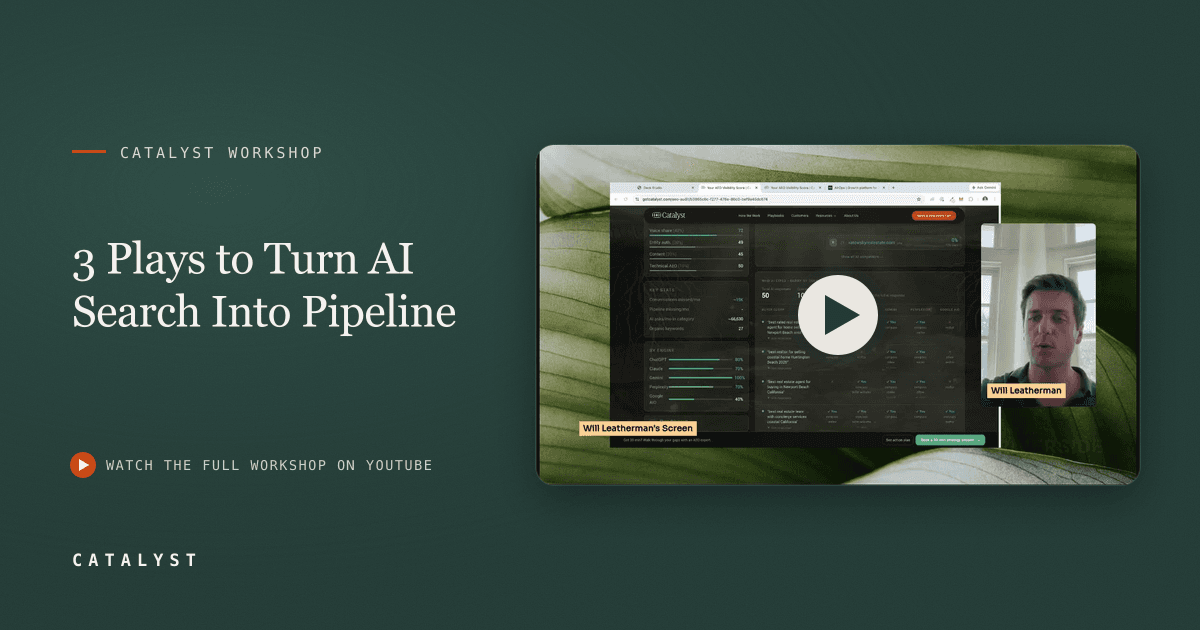
3 Plays That Turn AI Search Into a Revenue Channel for B2B Teams
Most B2B teams treat AI search as a brand awareness play. This workshop shows the 3-play system that turns it into a measurable pipeline channel, with a live audit demo and a real client generating $8 million from AI citations in 12 months.
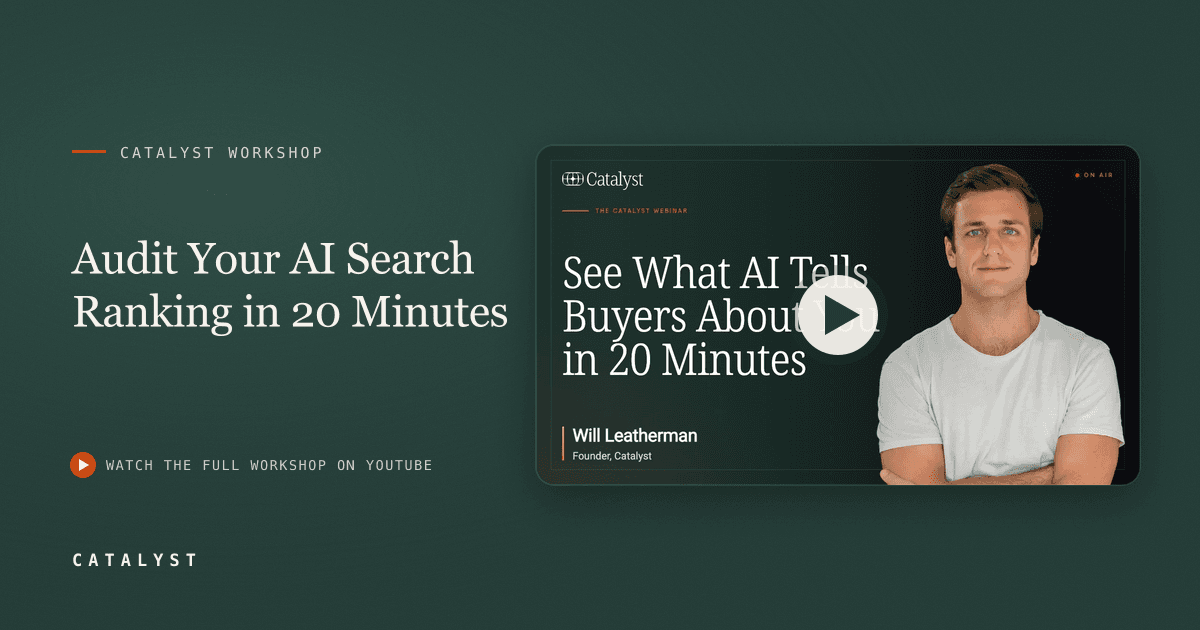
How to Audit Your AI Search Ranking in 20 Minutes
Most companies test their AI search visibility by asking their own ChatGPT or Claude account whether they appear, then assume the answer is accurate. This workshop shows what an unbiased audit actually reveals and the 3 specific gaps that determine whether AI recommends you or a competitor.
Ready to turn insight into pipeline?
We work with B2B companies that know content is the moat. Let's talk.