How to Build a Claude Workflow That Turns 1 Daily Idea Into 5 Ready-to-Post Drafts
Most B2B founders have content ideas they never ship. This 3-document setup and a single Claude co-work task changes that, producing platform-ready LinkedIn, Instagram, email, TikTok, and newsletter drafts from one captured idea every day.

Will Leatherman
Founder, Catalyst
TLDR
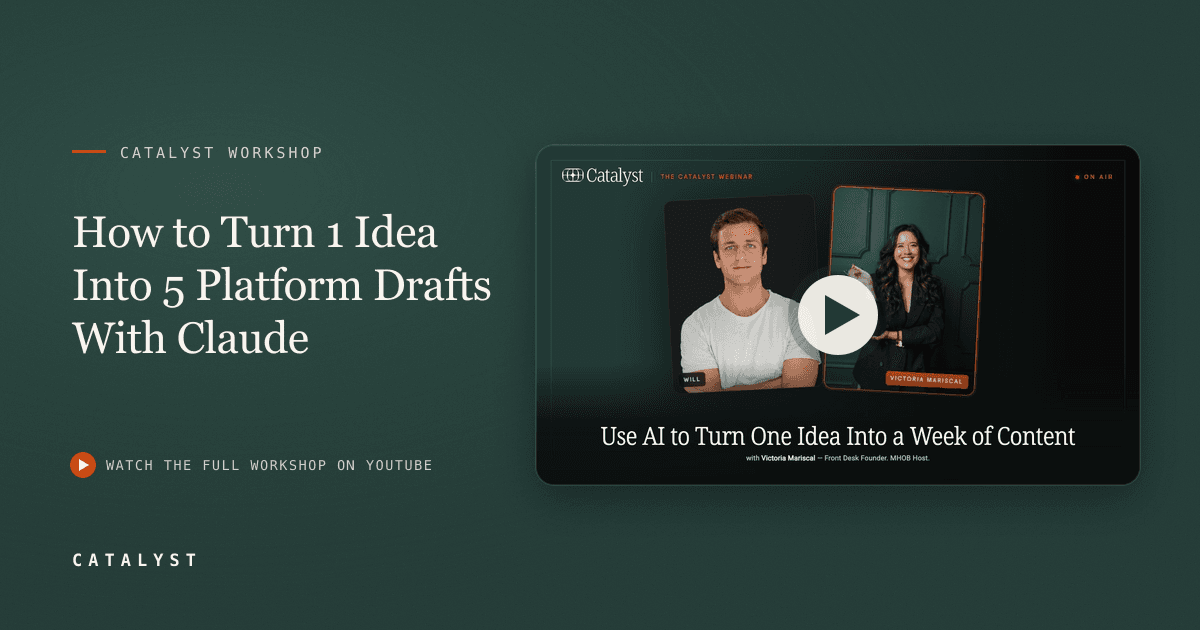
Set up a tone of voice doc, a platform guidelines doc, and a Notion idea capture form. Connect them to a scheduled Claude co-work task that runs daily. Every morning you wake up to 5 finished drafts, one per channel, written in your voice, from whatever idea you dropped the day before. Victoria from Front Desk ran this live in the workshop and noted that "about 90% of the work is done for you" once Claude knows how you write on LinkedIn.
Most founders are not failing to have ideas. In a Catalyst workshop on content systems, presenter Victoria Morales asked 17 B2B operators how many posted that week. 2 had. The rest either got distracted mid-draft, forgot the idea, or found a bigger fire to fight.
The problem is structural, not motivational. This article is the step-by-step build from that workshop.
What does the system actually produce?
Before the setup, here is what one idea turns into once the system is running:
| Channel | What Claude drafts | |---|---| | LinkedIn | Full post with recommended hashtags | | Instagram | Caption copy | | Email | Draft with subject line and body | | TikTok | Concept and hook | | Newsletter | Personalized intro section |
Every item is written in your voice, for your ICP, formatted per your platform rules. You review, finesse, and publish.
What are the 3 documents you need before touching Claude?
The system breaks without these. They are the memory Claude writes from.
1. Tone of voice document
Write down four things:
- How you like to write (direct, long-form, conversational, etc.)
- The topics you always return to — your core content pillars
- Phrases you naturally say
- Things you would never say (sentence fragments, trendy AI phrasing, anything that gives you an ick)
If you already have a library of posts, paste them into Claude and ask it to extract patterns. If you do not, spend 20 minutes writing it out manually. Victoria recommends downloading Whisper AI and voice-dictating it if typing slows you down.
"When you're able to define your tone of voice and you're able to teach your LLM how best to write for you on LinkedIn, about 90% of the work is done for you." — Victoria, founder of Front Desk
2. Platform guidelines document
One short section per platform you publish on. Tell Claude:
- Your preferred format for that platform (article, short post, thread, etc.)
- Structural rules (does your newsletter open with a personal story? does your LinkedIn post never use bullet points?)
- Any audience-specific framing differences
You do not need to fill every platform on day one. Start with the 2 or 3 channels you actually use.
3. Notion ideas database with a capture form
Create a Notion database with a form view. The form should capture:
- The idea (can be just a title)
- Optional context or story behind it
- Optional inspiration link (a post you saw and want to riff on)
Pin the form link to your phone home screen and your desktop. The whole point is frictionless capture: you have the idea in the shower, you open the form, you type the idea, done.
As Victoria put it, the goal is: "Anytime you have an idea, you have a very simple way to document it in one central place and have content push out every single day for you."
How do you configure the Claude co-work scheduled task?
This is where the 3 documents connect to automation.
- Open Claude and navigate to co-work → Scheduled → New task
- Name it (e.g., "Daily content drafts")
- Set the schedule: weekdays at 2pm works well, so drafts are ready the next morning
- Write the prompt — or use the template Victoria provides in the workshop. The prompt does 3 things:
- Points Claude at your Notion ideas database (paste the Notion page link)
- Tells Claude to reference your tone of voice and platform guidelines documents
- Instructs Claude to generate one draft per platform for each idea submitted that day
- Make sure your Notion and Slack connectors are enabled in Claude settings — the workflow reads from Notion and can notify you in Slack when drafts are ready
Save. That is the full setup.
What does the output look like on day one?
The first run will not be perfect. It will be surprisingly close.
When Victoria ran the task live during the workshop, the LinkedIn output came back with a post, hashtag recommendations, and copy formatted for her voice. Participants in chat called it "pretty close to postable."
The session's co-host Will noted: "After you have a few of these, go in and spend the time to really edit it down to make it sound like yourself — and feed that back in to keep your tone of voice document updated. It continues to get better."
The improvement loop:
- Run the task → review drafts → edit the ones you publish → paste the edited version back into a "reference drafts" section in your tone of voice doc
- After each run, prompt Claude: "Based on these drafts, what gaps do you see? What rules should you add for future runs?"
Within 30 days, the gap between first-draft and publish-ready narrows significantly.
How do you stop the system from going stale?
The platform guidelines doc needs updating as your audience and the platform algorithms shift. Victoria flagged this directly: "What happened in June is not what happened in January. The algorithm changes. So the more you're also feeding a platform guideline template with updated best practices, the better output you're going to get."
A practical maintenance rhythm:
- Review platform guidelines once a month
- Paste in the 3 highest-performing posts from the prior month and ask Claude to extract any new patterns
- Update what Claude should replicate and what it should drop
The takeaway
The system is: 3 documents + 1 Notion form + 1 scheduled Claude task. The payoff is never sitting down to a blank page again. The investment is a few hours upfront to write your tone of voice and platform rules carefully.
Victoria put the economics plainly: "The investment that you give to your content engine at the beginning is going to set you up for success long term, where you spend less and less time editing in the future."
Start with your tone of voice document today. It is the single highest-leverage input in the whole system — and every other piece runs through it.
The Content Engineer
Enjoyed this article?
Frameworks like this, weekly. No fluff — just original research and actionable insight.
More in Content Strategy
How B2B Marketing Teams Get Named in ChatGPT Perplexity and Google AI
86% of buyer queries go unanswered by most B2B companies in AI search. Here is the 3-component system to change that, grounded in a live audit of a real healthcare IT company.
How to get 30K YouTube views in your first month as a non-technical marketer
Louise de Sadeleer hit 30,000 views a month on YouTube in her first month as a non-technical creator. Her method treats YouTube as a search engine, not a talent show. Here is the exact 7-step workflow.
Ready to turn insight into pipeline?
We work with B2B companies that know content is the moat. Let's talk.