How to get 30K YouTube views in your first month as a non-technical marketer
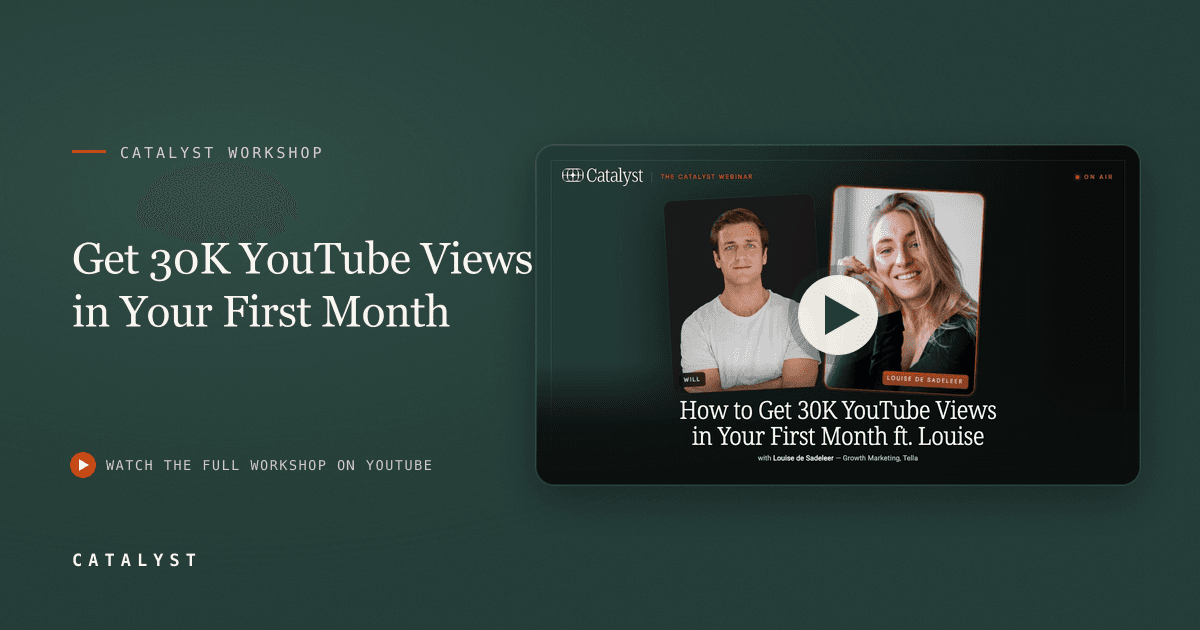
Louise de Sadeleer hit 30,000 views a month on YouTube in her first month as a non-technical creator. Her method treats YouTube as a search engine, not a talent show. Here is the exact 7-step workflow.

Will Leatherman
Founder, Catalyst
TLDR
Most people stall on YouTube because they try to win at entertainment. The faster path for marketers and technical founders is to treat YouTube as search: pick one audience, find rising keywords before they peak, and publish the most useful video on that term. This playbook breaks down the system Louise de Sadeleer used to reach 30K views in month one, including the Claude and Remotion B-roll workflow, the "I statement" title formula, and how to build a feedback loop from your own data.
A few months ago, Louise de Sadeleer had never made a YouTube video. She works in growth at Tella, not in video production. Two and a half months later, one of her early videos crossed 24,000 views, the channel cleared 30K views in its first month of real effort, and the numbers kept climbing.
She did it without a studio, without years of editing experience, and without trying to be entertaining. In a recent Catalyst workshop she walked through her exact process. This is that process, broken into steps you can copy.
Stop Competing on Entertainment. Compete on Search.
Most creators freeze on YouTube because the videos they admire come from teams with real production budgets. That is the entertainment game, and it is very hard to win from a standing start.
Louise plays a different game. She treats YouTube as a search engine. People do not find her videos because she is famous. They find them because she ranks for something they were already looking for.
"I see YouTube as more of an SEO or search engine optimization challenge."
That reframe changes what you make and how you make it. You stop chasing views and start answering questions. For B2B and technical creators, that is the unlock, because your audience is already searching YouTube for tutorials and tools.
Step 1: Pick One Audience and List Their Deepest Pains
Spend 30 minutes deciding who you are talking to. Louise knew she was not making videos for developers. She was making them for marketers and founders who want to make better video and put AI to work.
Then list that audience's deepest pains. The deeper the pain, the stronger the video.
- Editing takes far too long.
- The technical tools feel built for engineers, not marketers.
- Nobody explains the workflow simply enough to follow.
Frame every video as the answer to one of those pains, or as the path to a goal the viewer wants. The best educational videos answer a clear question or promise a specific outcome.
Step 2: Find Rising Search Terms Before They Peak
This is the core move, and it has a name: trendjacking. Publish on a topic that is already climbing in search so you are the top result when it explodes.
Louise opens VidIQ a few times a month and checks two numbers on any keyword: search volume and competition. Her rules of thumb:
- Target terms with 50K to 100K searches a month.
- Prefer terms flagged "rising" month over month.
- Get there early, before competition catches up.
The payoff compounds. When she made her video on Remotion, the term had roughly 150K monthly searches. It now sits above 1.1 million. Because she was early, her video rode the entire curve up.
Build the habit of noticing launches and viral moments on X, then asking one question: is this worth a video? Speed is the advantage, not polish.
Step 3: Don't Wait Until You're an Expert
The instinct is to master a tool before filming. Louise does the opposite, and she is blunt about why.
"If that's how you operate, I would challenge you to just not do that, because chances are the trend is going to be over."
Give yourself 1 to 2 weeks to experiment with a new tool, then record. Your edge is not deep expertise. It is your point of view and your role-specific workflow. A marketer covering an AI agent tool shows different use cases than a developer would, and that perspective is the value people stay for.
Step 4: Make the Boring Parts Watchable With B-Roll
The difference between a forgettable workflow video and a good one is B-roll. Most tutorials are 40 minutes of staring at someone's screen, and nobody finishes those.
Louise fixes this with Claude and Remotion. Her workflow:
- Download the subtitle file from your recording to get a timestamped transcript.
- Drop the transcript into Claude and ask it to find good spots to add B-roll generated in Remotion.
- Let Claude suggest the placements and generate the motion graphics, which render straight to MP4 overlays.
B-roll is more than animations. Use memes, movie or speech excerpts, images, and screenshots. Screenshots of real conversations make a video feel personal and specific, which is exactly what generic tutorials lack.
Step 5: Write Titles and Thumbnails That Earn the Click
Two formulas do most of the work here.
For titles, lead with an "I statement." "I built a company from scratch in 6 months" beats a flat how-to because it hints at a story. Louise is honest that no format lasts forever, but this one has held for a while, and it mirrors what we see working on LinkedIn: people now want the human who did the thing, not just the instructions.
Her title workflow is simple. Grab the winning keyword, paste your transcript into Claude, and ask it to write a title for that keyword. Claude weighs the options against search volume and competition and works in a clear outcome.
For thumbnails:
- Put a face on it. YouTube rewards faces.
- Lead the thumbnail text with an outcome or a job to be done.
- Use the thumbnail to say what you could not fit in the title.
Step 6: Engineer Retention With Rehooks
Getting the click is half the job. Keeping the viewer is the other half.
The title and thumbnail are the first hook. After that, set the stakes fast: name the problem and what you are going to accomplish. Then rehook every 60 to 90 seconds so people keep watching.
A few specific moves that work:
- Pack visual motion into the first 10 seconds. Louise's best videos are dense with cuts and graphics right at the start.
- Cut back to your face throughout. Your face is a rehook, and it breaks up long screen shares.
- Keep the intro short. Skip the "so one day I woke up" setup and get to the substance.
- Script the hook, not the whole video. For a process video, run through the steps the day before so they are fresh, then record unscripted.
Step 7: Build a Feedback Loop From Your Own Data
Once you have a few videos live, your own analytics become the best teacher.
Give Claude your best and worst performing videos and ask it to find the differences. Then have it grade new transcripts against that benchmark. It will tell you things like "your intro runs 8 minutes, but your best video's intro is 1 minute, so cut it."
You can also borrow structure from channels you admire. In the workshop, Will pulled 4 of Anthropic's workshops, had Claude transcribe them, and built a reusable "teach-demo loop" framework from how they alternate between teaching and live demos. Now he uses that framework to outline his own sessions.
Do not obsess over A/B testing early. Your data is too small to mean anything at first. Create from instinct, then formalize what works once the numbers can back it up.
The Tool Stack
The full kit Louise and Will reference in the session:
- Tella for screen recording and editing (use code WILL30 for 30% off for 12 months).
- Claude for B-roll planning, titles, editing, and analysis.
- Remotion for AI-generated motion graphics.
- VidIQ for keyword and search-volume research.
- CapCut for its sound and font libraries.
- Overlap or Opus for auto-cutting shorts.
The Takeaway
YouTube is not a talent show you have to win. It is a search engine you can rank on. Pick one audience, find the question they are already asking, and publish the most useful answer before everyone else does. The tools to make it watchable now fit inside a single afternoon's learning curve. The only thing left is to hit record.
The Content Engineer
Enjoyed this article?
Frameworks like this, weekly. No fluff — just original research and actionable insight.
More in Content Strategy
How to Build a Claude Code Engine That Turns Any Transcript Into a Week of Platform-Native Content
Most B2B teams leave their best content buried in recordings. This workshop walks through a live Claude Code build that mines any transcript for ideas, writes platform-native drafts in your voice, and schedules itself to run every week without manual input.
How B2B Marketing Teams Get Named in ChatGPT Perplexity and Google AI
86% of buyer queries go unanswered by most B2B companies in AI search. Here is the 3-component system to change that, grounded in a live audit of a real healthcare IT company.
How to Build a Claude Workflow That Turns 1 Daily Idea Into 5 Ready-to-Post Drafts
Most B2B founders have content ideas they never ship. This 3-document setup and a single Claude co-work task changes that, producing platform-ready LinkedIn, Instagram, email, TikTok, and newsletter drafts from one captured idea every day.
Ready to turn insight into pipeline?
We work with B2B companies that know content is the moat. Let's talk.