What is co-citation for AEO and why is it important?
AI models decide what your brand is relevant for by reading who it is mentioned with. Here is what co-citation for AEO is, why it matters, and how Catalyst engineers it.

Will Leatherman
Founder, Catalyst

TLDR
- Co-citation is how often two brands are mentioned together across the web. - AI models learn category relevance from co-occurrence, not just backlinks. - Unlinked brand mentions count as much as linked ones in AI search. - The brands you are listed beside define what buyers are told you do. - Catalyst engineers co-citation for AEO so models cite you with the right peers.
Co-citation for AEO is the practice of engineering which brands, sources, and topics get mentioned alongside yours, because AI models do not judge your page in isolation. They retrieve clusters of sources and learn who belongs with whom. Recent research found that brands earning both a mention and a citation were 40% more likely to reappear across consecutive AI answers (Source: AirOps). The companies the model lists next to you are quietly defining what you are relevant for.
At Catalyst, co-citation sits at the center of how we earn citations for B2B startups. We produce and analyze over 150 LinkedIn assets every week, and we treat the question of who your brand is mentioned with as a deliberate input, not an accident. Here is what co-citation is, why it matters for AEO, and how to build it on purpose.
Key Takeaways
- Co-citation is how often two brands are mentioned together across the web.
- AI models learn relevance from co-occurrence, not just backlinks.
- Unlinked brand mentions count as much as linked ones for AEO.
- Catalyst engineers co-citation for AEO so models list you with the right peers.
- The brands you appear beside define what buyers are told you do.
What Is Co-Citation in the Context of AEO?
Co-citation is the frequency with which two sources are mentioned together by a third, independent source, and for AEO it is the signal that teaches a model which brands belong in the same category. The idea comes from academic citation analysis: when two papers are repeatedly cited side by side, they are treated as related. AI search applies the same logic to brands. The more often your company appears next to a given competitor, tool, or topic across the web, the more confidently a model associates you with it. We unpack the foundation this rests on in 3 ways B2B startups can build entity authority.
- Co-citation: two brands mentioned together in a third source.
- Co-occurrence: your brand mentioned near a topic or keyword, even without a link.
- Both shape the associations a model forms about your category.
- Neither requires a hyperlink to count.
In AI search, the context around your name does the work that a backlink used to do.
Why Does Co-Citation Matter for AEO?
Co-citation matters for AEO because AI models build their shortlist from the company you keep, not from a ranked list of pages. When a buyer asks for the best option in your category, the model returns the entities it has seen described together as credible peers. If you are never mentioned alongside the leaders, you are invisible to that question, regardless of how good your own pages are. This is a big part of why AEO is becoming the top lead source for B2B startups.
- Models recommend brands they have seen grouped with trusted peers.
- Being absent from category lists means being absent from the answer.
- Co-citation compounds: each mention makes the next association stronger.
- It is something a focused startup can influence faster than domain age.
Your relevance in AI search is decided largely by who you are listed beside.
Curious which brands the models already list alongside yours? You can see how your company shows up across ChatGPT, Perplexity, Gemini, and Claude with a free AI citation audit.
How Is Co-Citation Different From Backlinks?
Co-citation is different from backlinks because it does not need a link to work; an unlinked mention in a trusted source can carry as much weight as a hyperlink in AI search. Traditional SEO asked whether you earned the link. AEO asks how your brand was described and what it was mentioned next to. A name-drop in a respected roundup, with no link at all, can move your citation odds more than a do-follow link from a thin blog. The research behind this shift is summarized in what Ahrefs' 2026 AEO report reveals about AI citations.
- Backlinks pass authority through a link; co-citation passes it through context.
- Unlinked mentions still register as entity associations.
- Best-of lists are among the most-cited formats in AI answers.
- The same PR that earns links usually earns co-citations as a by-product.
For AEO, what surrounds your name matters more than whether it is clickable.
How Do AI Models Use Co-Citation to Decide What to Recommend?
AI models use co-citation by retrieving groups of sources together and reading the patterns in how brands co-occur, then surfacing the entity that fits the query most cleanly. Rather than scoring one page at a time, the model assembles an answer from a pool of related sources and leans on the associations it has already learned. If your brand consistently appears near a category and its leaders, you become part of the cluster the model pulls from. We walk through this retrieval-to-recommendation path in how Catalyst gets B2B startups clients from AI search engines.
- Models retrieve clusters of sources, not isolated pages.
- Repeated co-occurrence trains the brand-to-category association.
- Lists and comparisons are dense co-citation signals models trust.
- Consistent context across sources reduces the model's uncertainty about you.
Show up in the right groups often enough and you become the obvious answer.
How Do You Build Co-Citation for AEO on Purpose?
You build co-citation for AEO by deliberately placing your brand in the same trusted contexts as your category and its leaders, then doing it consistently until the association sets. This is not a one-week campaign; it is a sustained motion of original insight, earned mentions, and presence on the sources models trust. The fastest lever is publishing data and points of view distinctive enough that others quote you by name. The deliberate build is the same one behind 3 ways B2B startups can build entity authority.
- Publish original research so others cite you alongside the category.
- Earn mentions in best-of lists and comparisons that group brands.
- Get represented on high-citation sources like review sites and communities.
- Keep messaging consistent so every mention reinforces the same association.
Co-citation is earned with repetition, and the brands that start now set the pattern.
Want this built for your startup? You can book a discovery call and we will map the fastest path to the right co-citations in your category.
How Do You Measure Co-Citation for AEO?
You measure co-citation for AEO by tracking which brands and sources appear alongside yours across AI answers, then tying that share of association to the citations and pipeline it produces. Counting raw mentions is not enough; the useful question is whether you are co-cited with the leaders for the queries that matter, and whether those answers convert. Because AI-referred traffic is low in volume and high in intent, conversion quality is the real scoreboard. We documented those economics in B2B conversion rates from AEO.
- Track which competitors and sources you are co-cited with, by query.
- Watch share of association move as you publish and earn mentions.
- Tie AI-referred visits to conversions, not vanity counts.
- New reporting tools make part of this visible, as covered in Google's generative AI performance reports.
Once you can see the pattern, you can engineer it and forecast it.
The Bottom Line on Co-Citation for AEO
Co-citation for AEO comes down to a simple truth: AI models decide what you are relevant for by reading who you are mentioned with, and brands earning both a mention and a citation are 40% more likely to reappear across consecutive answers (Source: AirOps). Backlinks no longer carry the channel alone; the context around your name does. Catalyst engineers co-citation as part of one connected engine, from earning the right mentions to converting the warm visit, so AI search becomes a predictable source of clients rather than a lucky break.
Read Next:
- 3 Ways B2B Startups Can Build Entity Authority to Get More Clients from LLMs
- Why AEO Is Becoming The Top Lead Source for B2B Startups
- What Ahrefs' 2026 AEO Report Reveals About AI Citations
Ready to be the brand the models list first? Book a discovery call with Catalyst and we will build the co-citation into your AEO engine.
Frequently Asked Questions
What Is Co-Citation for AEO?
Co-citation for AEO is how often your brand is mentioned together with other brands, sources, or topics across the web, which teaches AI models what category you belong to. Unlike a backlink, it works through context rather than a link. Catalyst engineers co-citation so models associate your startup with the right peers and queries.
Why Is Co-Citation Important for AEO?
Co-citation is important for AEO because AI models build recommendations from the brands they have seen grouped together, so the company you keep decides whether you make the shortlist. If you are never co-cited with the leaders, you miss the answer entirely. Catalyst treats co-citation as a deliberate input to earning more AI citations.
How Is Co-Citation for AEO Different From Backlinks?
Co-citation for AEO is different from backlinks because it does not require a link; an unlinked mention in a trusted source can carry as much weight as a hyperlink. Traditional SEO optimized for links, while AEO optimizes for how and where your brand is described. Catalyst builds both, but prioritizes the context that AI models actually read.
How Do You Build Co-Citation for AEO?
You build co-citation for AEO by publishing original insight and earning mentions in the trusted sources and lists where your category is discussed, then repeating it until the association sets. Consistency is what turns scattered mentions into a durable signal. Catalyst runs this as a sustained motion rather than a one-off PR push.
How Do You Measure Co-Citation for AEO?
You measure co-citation for AEO by tracking which brands and sources you appear alongside in AI answers, then tying that share of association to citations and pipeline. Raw mention counts matter less than being co-cited with the leaders on high-intent queries. Catalyst sets up this tracking so the channel is provable to leadership.
The Content Engineer
Enjoyed this article?
Frameworks like this, weekly. No fluff — just original research and actionable insight.
More in AEO

3 ways B2B startups can build entity authority to get more clients from LLMs (and how Catalyst helps)
B2B startups winning clients from LLMs build entity authority deliberately. Here are 3 ways to do it, and how Catalyst engineers it at scale.
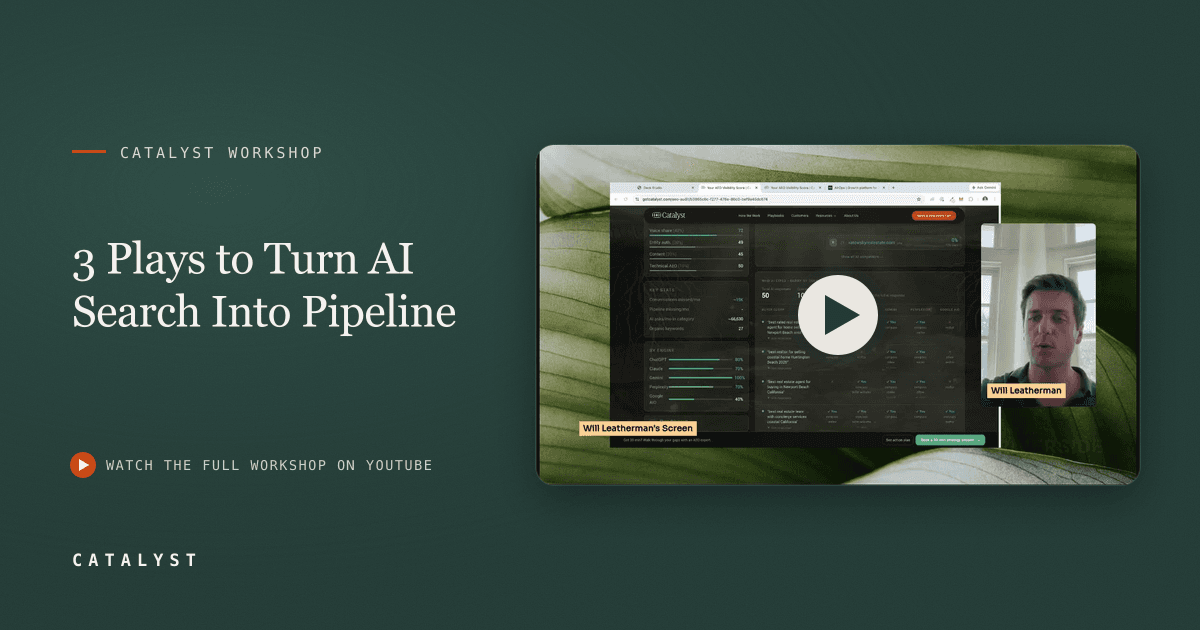
3 Plays That Turn AI Search Into a Revenue Channel for B2B Teams
Most B2B teams treat AI search as a brand awareness play. This workshop shows the 3-play system that turns it into a measurable pipeline channel, with a live audit demo and a real client generating $8 million from AI citations in 12 months.
ChatGPT vs Claude Citations: How to Rank for Both
Only 13% of the domains ChatGPT cites are also cited by Claude. Here is why the two engines diverge, what each one actually rewards, and how Catalyst wins citations on both from a single entity foundation.
Ready to turn insight into pipeline?
We work with B2B companies that know content is the moat. Let's talk.